


Tips for Choosing the Perfect Pear Cut Diamond

When it comes to pear shaped diamonds, most buyers don't struggle with wanting one; they struggle with choosing one without getting it wrong.
Celebrities like Megan Fox and Adele chose this cut for their jewelry. They are not trend-followers. They deliberately chose a shape that delivers more visual impact per carat than almost any other cut on the market, and faces up 8% larger on the finger than a round brilliant of the same weight.
Here's what nobody tells you upfront: the GIA issues no cut grade for pear cuts. No certificate flags a bow-tie. The only way to know whether your stone carries a dead shadow across its center is to see it, before you pay. This guide gives you the exact visual criteria to make that call yourself.
Understanding the Pear Cut Diamond
The pear cut diamond's origin story starts with one man and one invention, and it's worth knowing both before you shop.
In 1475, a Flemish diamond polisher named Lodewyk van Berquem invented the scaif - a spinning wheel coated in oil and diamond dust that allowed cutters - for the first time, to place facets with absolute symmetry. That breakthrough produced the pendeloque cut, the historical name for the pear shape and locked in 58 facets as its standard. Five hundred and fifty years later, every pear cut diamond you find still carries those same 58 facets. The architecture hasn't changed because it doesn't need to.
But here's what makes the pear cut genuinely different from every other shape on the market.
It's a structural hybrid, and that's not marketing language, it's modified brilliant faceting in action. The rounded crown handles brilliance exactly the way a round brilliant does. The elongated body toward the pointed tip handles fire the way a marquise does. The result isn't a compromise between two shapes. It's more visually complex than either shape produces alone.
That hybrid geometry is why the face-up appearance of a pear cut appears larger on the finger than that of a round brilliant of identical carat weight. Larger surface area, more light interaction, more presence at the same price point.
And it's also why the pear cut introduces evaluation variables that a round brilliant simply doesn't carry. Proportions. Bow-tie performance. Color behavior at the tip. None of them appear anywhere on a certificate, which means the buyer who understands them walks into the search with a real advantage.
Key Factors to Consider When Choosing a Pear Cut Diamond
One common mistake buyers make with pear-shaped diamonds is assuming that the certificate tells the whole story. Unlike some other diamond shapes, a pear cut cannot be judged by a single score alone. Its beauty depends on a combination of factors, including proportions, overall shape, the bow-tie effect, clarity and inclusions, and color. Once you know what to look for, you can evaluate a pear-shaped diamond with confidence.
Proportions and Shape

Think of the length-to-width ratio as the personality of the stone. The GIA places the preferred range between 1.50 and 1.75 , and every decimal point within that range changes how the ring reads on the finger. A ratio below 1.50 gives you something that looks squat and erases the sleek, elegant silhouette that makes the shape iconic. Push it above 1.75, and the stone starts looking delicate in a way that feels fragile, not refined.
The sweet spot, 1.55 to 1.65, produces that long, elegant silhouette that photographs beautifully and looks even better in real life.
The Bow Tie Effect

The bow-tie is the one thing every pear cut buyer worries about, and it deserves every bit of that attention. The GIA describes it as a dark shadow running across the width of the stone, caused by light failing to reflect back through the central facets entirely. That's called light extinction, and unlike most diamond flaws, no certificate grade captures it, no clarity plot maps it, and no amount of studio lighting reveals it in a static product photo.
A well-cut pear shaped diamond carries a barely-there bow-tie that disappears the moment the stone catches light and moves. A poorly cut one carries a permanent dark band that kills the brilliance the shape is famous for.
The only way to know which one you're looking at is through a 360° video, ideally filmed under natural light, not a lightbox. A stone with crushed ice faceting scatters light into fine, sparkling fragments that can soften a minor bow-tie.
Clarity and Inclusions

Good news: the pear cut diamond's modified brilliant faceting is remarkably good at hiding inclusions. Those 58 facets scatter light in so many directions that a VS1 or VS2 stone looks absolutely flawless on the finger, at any distance, under any lighting condition, including the ones at your rehearsal dinner. The IGI certifies lab grown pear cuts for clarity and confirms the grade, but doesn't map exactly where inclusions sit within the stone.
That location detail matters; an inclusion near the knife-edge tip sits in a far more visible position than one tucked beneath the shoulder. So VS1 is your benchmark: completely eye-clean, genuinely invisible without magnification, and meaningfully more affordable than VVS2 with zero visual trade-off on the finger.
Color Considerations
Here's the color rule that catches most buyers off guard: the pear cut's pointed tip concentrates body color more intensely than the rounded crown. The GIA confirms this behavior across all fancy shapes with tapered ends, which means the color grade that looked perfect on your round brilliant will read slightly warmer in a pear cut.
For lab grown pear cuts specifically, G color or above is the benchmark that delivers the crisp, bright white face-up appearance the shape deserves. Drop to H or below, and the tip can read warm under restaurant lighting - romantic in theory but not what you envisioned when you saved those Instagram posts.
And check the IGI certificate for the production method. CVD stones can occasionally carry a subtle grey undertone under certain lighting conditions. HPHT stones tend to run warmer. Neither is a flaw, but knowing which one you're working with tells you exactly what lighting to test it under before you fall in love with it on a screen and commit.
Choosing the Right Setting for a Pear Cut Diamond
Once you have chosen the stone, the next part is the setting.
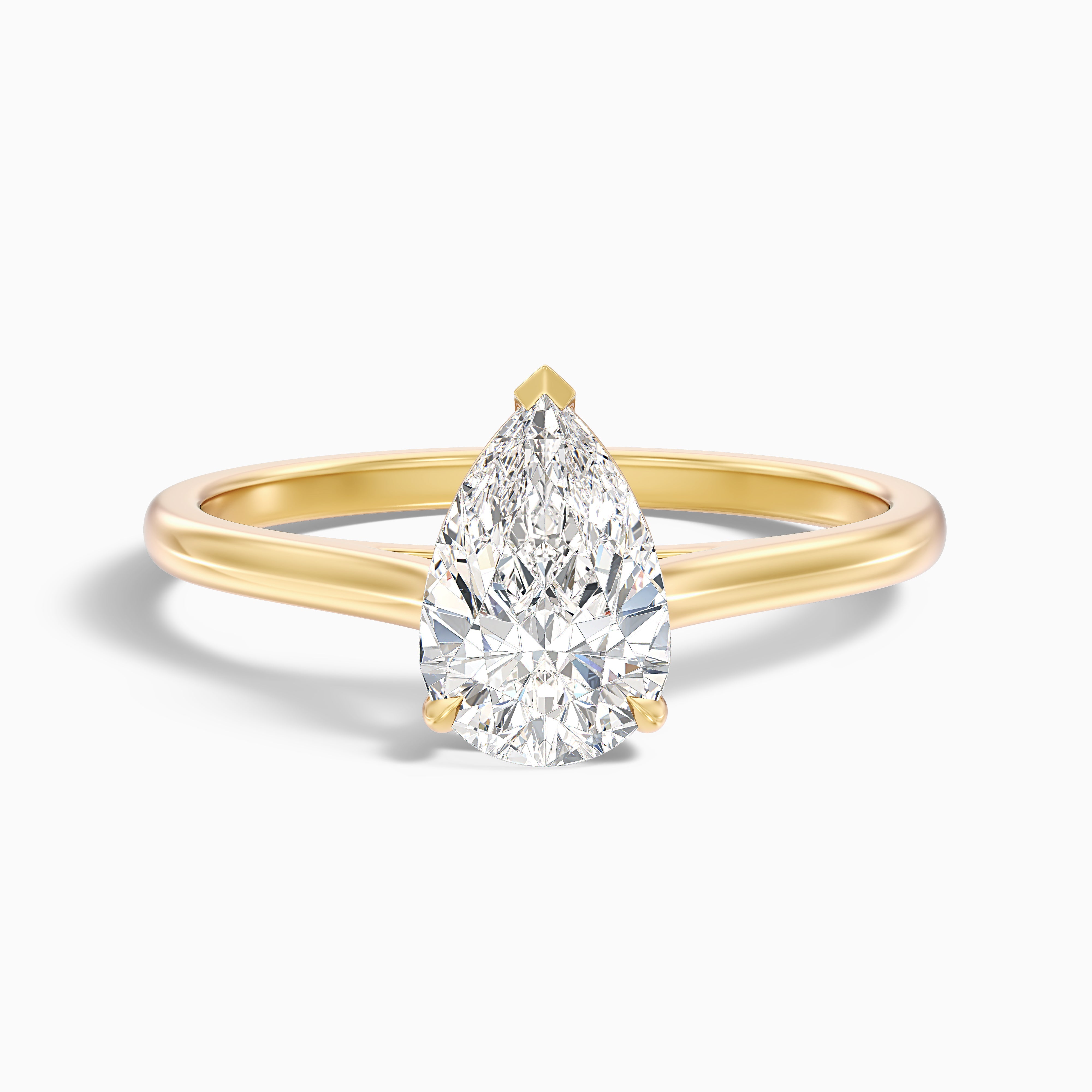
A standard four-prong setting leaves the pointed tip of the stone completely exposed, and that tip is the most structurally vulnerable point on any pear cut. One catch on a sweater seam, one knock against a kitchen counter, and that knife-edge point chips. It's not a question of if. It's a question of when.
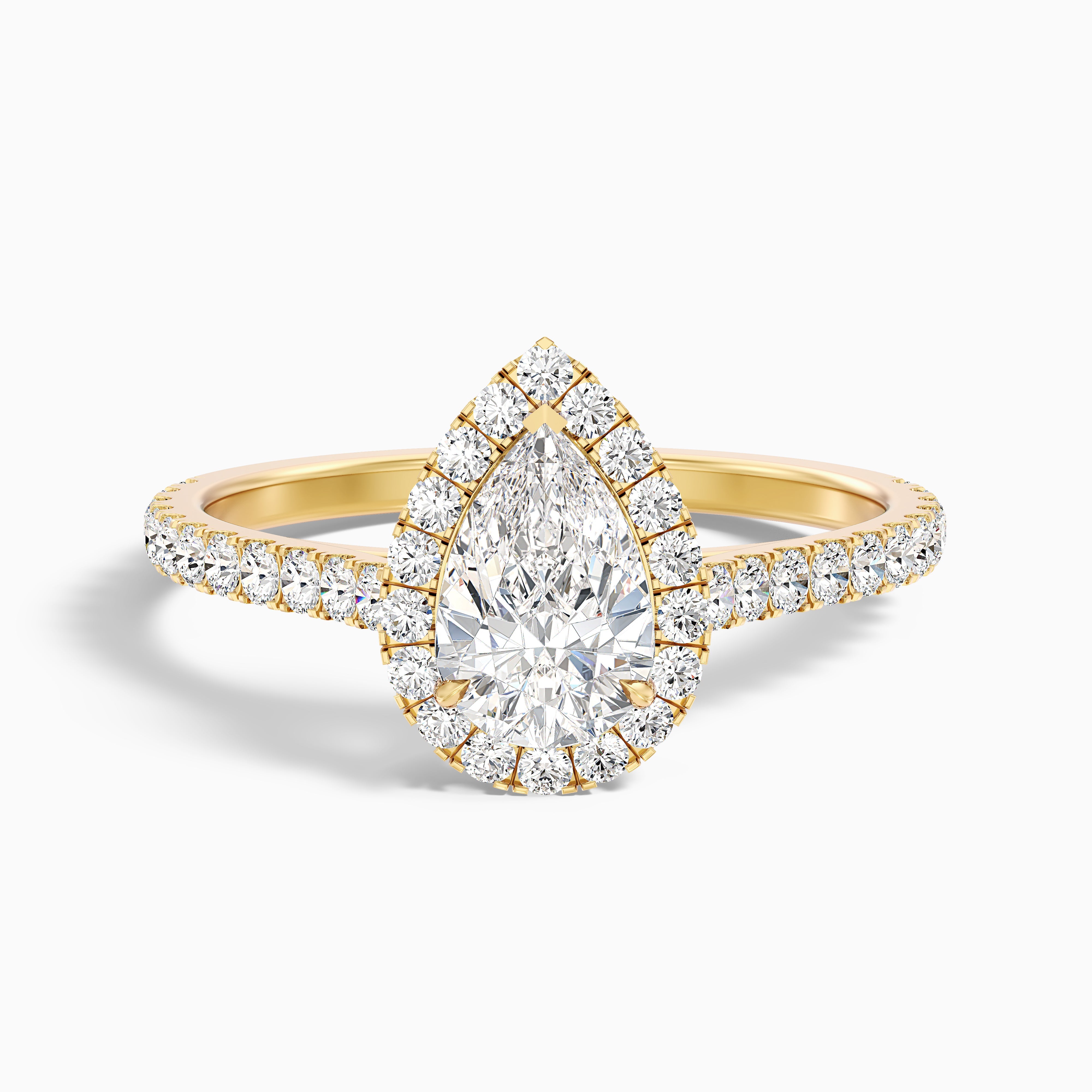
A V-prong protects the tip, while a bezel offers maximum coverage.
A slim band helps enhance the pear’s elongating effect. The stone you spent weeks choosing deserves a setting that amplifies its striking silhouette.
As for how to wear a pear shaped diamond, the tip pointing toward the nail is the most universally flattering orientation. It extends the line of the finger and shows the full silhouette of the shape from across a room. Some women flip it inward toward the wrist for a more unexpected look. Both are right. But you'll want to see both orientations on your actual hand, in your actual lighting, before the ring ships.
At CaratBee, our CAD-assisted process lets you review the design before production begins.
 Customize Now
Comparing Pear Cut Diamonds to Other Shapes
You've probably been toggling between tabs for weeks, pear, oval, maybe marquise, saving photos, second-guessing yourself, and getting no closer to a decision. Here's the honest comparison that closes those tabs.
-
Pear vs. Round
The round brilliant is the benchmark every other shape gets measured against, and for good reason. It carries an official GIA cut grade, which means the certificate does the evaluation work for you. The pear cut doesn't have that. But what the pear cut does have is a face-up appearance that is larger than that of a round brilliant of identical carat weight.A 1.5-carat pear cut reads on the finger like a round brilliant, closer to 1.65 carats, at the exact same price point. And the elongating effect on the finger? The round brilliant simply doesn't compete with that.
-
Pear vs. Oval
When it comes to pear vs oval diamond, this is genuinely the closest call in the fancy shape category, and both are worth wearing. The oval distributes light evenly across its entire surface, producing a soft, symmetrical brilliance that flatters almost every hand. The pear does something architecturally different: it concentrates brilliance at the rounded crown and produces more dramatic fire at the tip, creating a directional silhouette the oval never quite achieves. The oval also carries two rounded ends, zero knife-edge vulnerability. The pear's pointed tip demands a V-prong. If you love the elongating effect but want lower-maintenance daily wear, the oval wins. If you want a ring that turns heads from across the room, the pear's modified brilliant faceting delivers something the oval's geometry physically can't.
-
Pear vs. Marquise
The marquise shares the pear's elongated body and dramatic finger presence, but it carries two knife-edge points instead of one, doubling the setting protection requirement and the chip risk of daily wear. Both shapes demand V-prong protection at every tip. But the pear's rounded crown produces a softer, more wearable silhouette that reads as contemporary and refined. The marquise reads sharper, more vintage, more angular. Neither is wrong, but the pear fits better in 2026 without feeling like it's trying too hard.
You now have the comparison you need, not a sales pitch but a working framework built on actual structural differences.
Related Article: Pear Shaped Engagement Ring: The Complete Guide
Conclusion
You now know exactly what to look for, and that changes everything about how you shop.
An IGI-certified lab grown pear cut means the stone you choose carries no mining footprint and no conflict supply chain at a fraction of the cost of its mined equivalent. The only thing left is choosing a brand that enforces these gemological standards before you ever see the stone.
Book a consultation with CaratBee. Tell us the proportions you want. We'll show you the stones we've already handpicked to match your preference.


